
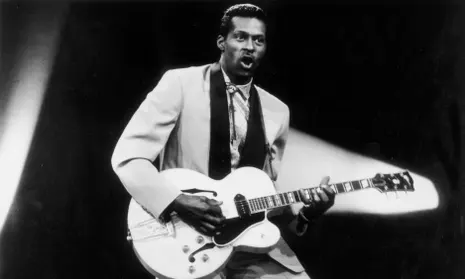

Imagine you are a promoter in a small 1950s American town. You have booked the legendary Chuck Berry, the man whose guitar riffs defined the dawn of Rock ‘n’ Roll. You expect an entourage of roadies, a manager, and a seasoned backing band that has toured with him for months. Instead, a lone man walks into your venue carrying nothing but his Gibson guitar, looking for anyone who can hold a beat. This was the surreal, often chaotic reality of touring with the most unpredictable architect of rock music.
At the height of his fame, Chuck Berry traveled completely alone, bypassing the traditional security and comfort of a professional ensemble. While icons of the era were busy curating massive, ego-driven productions, Berry took a radically different, almost reckless approach. He would arrive in town, head to a local music shop or lounge, and recruit total strangers—often musicians who had never played his songs before—to back him on stage. To the audience, he was the untouchable star; to the band, he was a demanding, mercurial taskmaster who insisted on his own specific, unyielding rhythm.
This wasn’t just a cost-cutting measure; it was a testament to the sheer, raw confidence of Chuck Berry. He didn’t need a band that knew his nuances; he needed a band that could keep up with his pace, and he forced them to learn it on the fly. Many of these local players found themselves thrust into the spotlight, terrified yet exhilarated, playing ‘Johnny B. Goode’ or ‘Maybellene’ with a legend who didn’t even bother to learn their names. It is a story that feels like it belongs in the dusty, neon-lit corridors of an old roadside Jukebox, a piece of music history that feels more like an urban legend than fact.
Behind this strange behavior lay a man who was deeply protective of his earnings and suspicious of the music industry’s predatory nature. By traveling solo, Chuck Berry maintained total control over his bookings and his bottom line. Yet, this isolation contributed to the enigmatic, sometimes abrasive reputation that followed him throughout his career. There were nights where the chemistry was electric, a spontaneous combustion of talent, and nights where the performance teetered on the edge of disaster, saved only by the unstoppable force of his songwriting.
Looking back at that golden era of Rock ‘n’ Roll, Chuck Berry remains a polarizing figure, equal parts genius and mystery. His decision to treat music like a nomadic craft, rather than a corporate machine, tells us everything about the man behind the hits. He didn’t care for the trappings of fame; he cared for the music, the money, and the freedom of the open road. His legacy is not just in the records he left behind, but in the memory of those lucky strangers who once shared a stage with a titan, never knowing if their night with him would end in a standing ovation or a silent exit into the dark. Next time you hear those iconic opening notes, remember the man who walked into town with only a guitar and a dream to command the stage alone.