

In the shadowy corners of Parisian cafés, film critics still whisper about her. The woman who could break hearts with a single glance, who made mystery itself an art form. Catherine Deneuve didn’t just become a star—she became an obsession. For nearly seventy years, she has graced screens around the world, accumulating nearly 99 million admissions in French theaters alone. But what is it about this ethereal beauty that has kept audiences spellbound since she was merely twelve years old? The answer lies in a truth so captivating, it reads like the plot of her most famous films.

The Birth of an Icon: When a Child Became Cinema’s Greatest Enigma
Picture this: 1956, a twelve-year-old girl named Catherine Fabienne Dorléac stands before a camera for the first time. She doesn’t know it yet, but this moment will launch one of cinema’s most extraordinary journeys. By 1957, when the film debuts, thirteen-year-old Catherine has already chosen her stage name—Deneuve—and begun her transformation into something beyond mortal understanding.
The New Wave crashed over French cinema like a tidal wave, and there she was, riding its crest alongside legends like Brigitte Bardot and Alain Delon. But while others blazed with obvious fire, Catherine possessed something far more dangerous: the allure of ice. Directors like Luis Buñuel, François Truffaut, and Roman Polanski saw it immediately. Here was an actress who could embody the untouchable, the unknowable.
Her breakthrough came through musical films—*The Umbrellas of Cherbourg*, *The Young Girls of Rochefort*—where her voice became as hypnotic as her presence. But even as she sang, there was something held back, something that suggested depths no camera could fully capture.
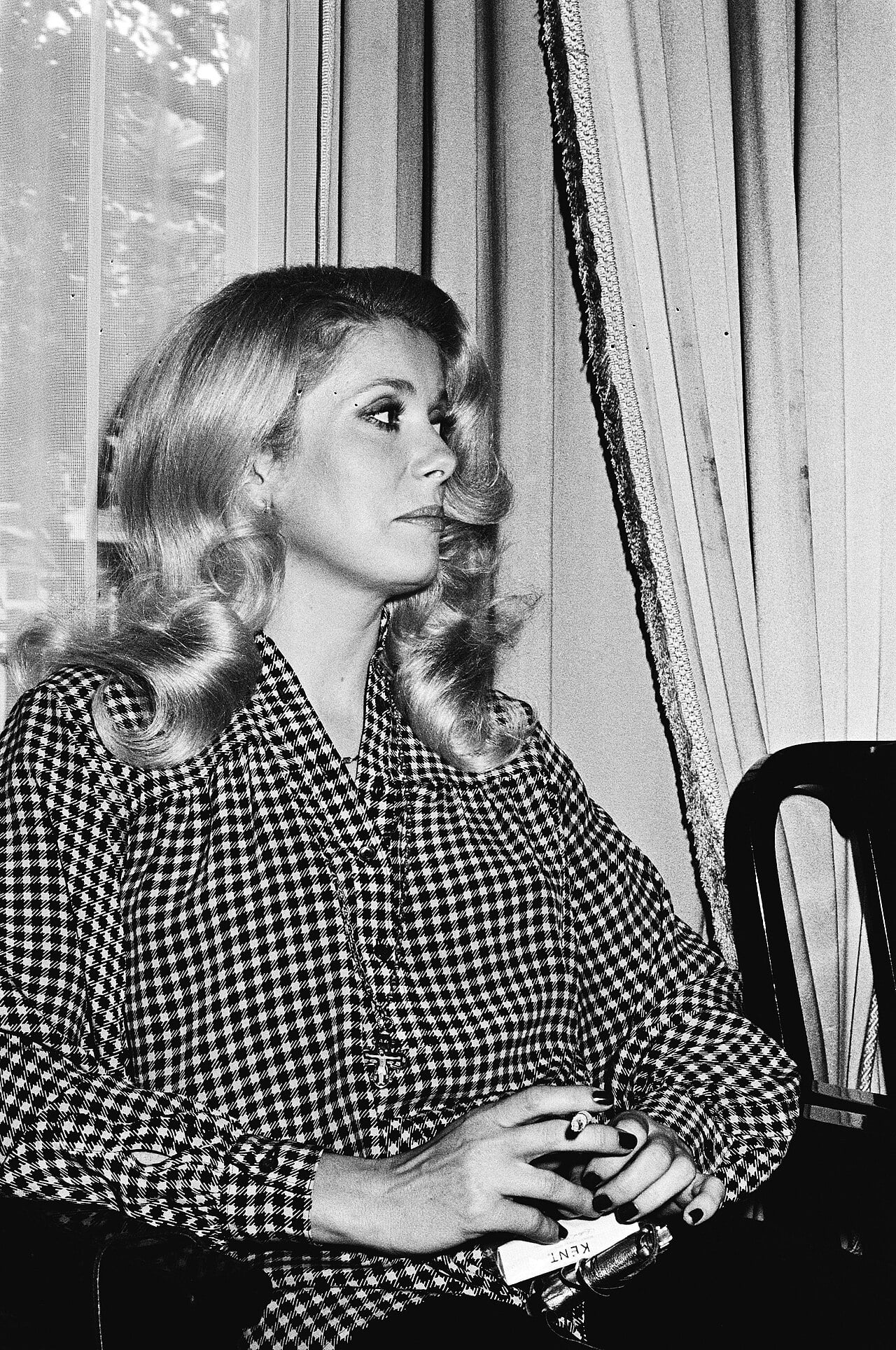
The Sphinx of Cinema: Crafting the Perfect Mystery
What makes a woman unforgettable? Catherine Deneuve discovered the answer: never reveal everything. From the beginning, she specialized in playing “aloof and mysterious beauties,” characters who seemed to know secrets they would never share. This wasn’t just acting—this was alchemy.
Watch her in *Belle de Jour* or *Repulsion*, and you’ll see a performer who understands that true power lies in restraint. Her blue eyes could suggest a thousand stories while telling none. Critics scrambled to decode her performances, audiences left theaters haunted by questions they couldn’t even articulate.
She became France itself—literally. In 1985, she was chosen as the official face of Marianne, the nation’s symbol of liberty. But this honor only added another layer to her mystique. How perfect that a country built on revolution would choose as its symbol a woman who had mastered the art of keeping secrets.
Her international acclaim followed naturally. The Venice Film Festival’s Volpi Cup, a César Award, Academy Award nominations—each accolade only deepened the mystery. How could someone so celebrated remain so enigmatic?

The Heart Behind the Mystery: Love Stories Written in Starlight
Here lies the secret that has defined Catherine Deneuve’s seven-decade reign: she didn’t just play romantic roles—she lived romance as an art form. But not the obvious kind that tabloids devour. Her romance was with cinema itself, with the very act of transformation.
Consider her journey across continents: America with Robert Aldrich and Tony Scott, Italy with Marco Ferreri and Mario Monicelli, Spain with Buñuel, Denmark with Lars von Trier, even Japan with Eric Khoo. Each collaboration was a love affair with different cinematic languages. She didn’t just work with these directors—she danced with them, creating magic that transcended cultural boundaries.
Her roles in *The Hunger* introduced her to English-speaking audiences as a vampire, but wasn’t that perfect casting? She had always been a creature who fed on mystery, who sustained herself on the life force of her audience’s fascination.
The numbers tell their own love story: nearly 99 million admissions, making her the working actress with the most theater visits in France. Each ticket sold was a heart claimed, each screening a secret rendezvous between star and spectator.

The Eternal Enigma: A Legacy Wrapped in Starlight
Even now, as honors accumulate—Berlin’s Honorary Golden Bear, Cannes’ Honorary Palme d’Or, Venice’s Golden Lion for Lifetime Achievement—Catherine Deneuve remains beautifully, maddeningly unknowable. The New York Times called her one of the greatest actors of the 21st century, but that only scratches the surface.
She has given us a hundred roles, yet somehow, after seventy years, we still feel like we’ve only glimpsed her true self through frosted glass. Perhaps that’s her greatest achievement: in an age of oversharing, she has preserved the most precious thing an artist can possess—mystery itself.
The question that opened this story remains unanswered, and perhaps that’s exactly as it should be. Catherine Deneuve’s secret isn’t something to be solved—it’s something to be eternally, hopelessly, beautifully lost in.

Photos via Wikimedia Commons (public domain / Creative Commons).